all pics

Sunday, June 24, 2012

Library Archives Canada on Dr Norman Bethune

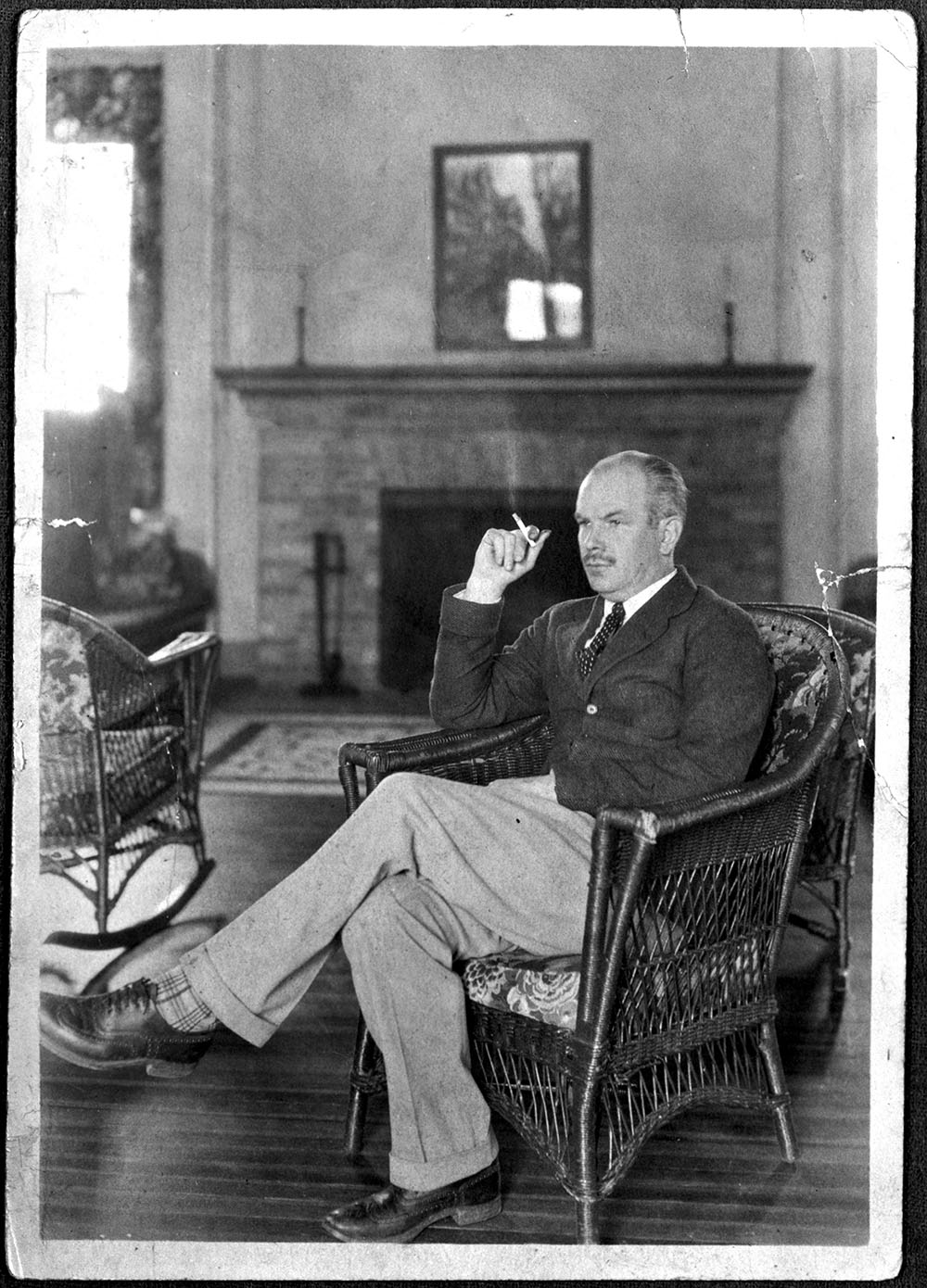
Dr. Norman Bethune

Photograph of Norman Bethune, 1928

Source
Norman Bethune, 1928

Illustration of Dr. Norman Bethune

Source
Norman Bethune (1890-1939), by Francine Auger

Dr. Norman Bethune is best known as a hero in the People's Republic of China and for his impact on Sino-Canadian relations. But he also gained a reputation in his native Canada as a gifted surgeon, an inventor, a political activist and an early proponent of a universal health care system.

Norman Bethune was born in 1890 in Gravenhurst, Ontario, north of Toronto. He was the son of a clergyman but chose to follow in his grandfather's footsteps and become a surgeon. He studied at the University of Toronto's Faculty of Medicine but, in 1911, he interrupted his studies to work for a year as a labourer-teacher with Frontier College.

Wartime service

At the outbreak of the First World War, Bethune joined the N0.2 Field Ambulance Medical Corps and sailed for France in February 1915. He was working as a stretcher-bearer in Ypres, Belgium, when a shrapnel shell exploded close to him and pieces of it pierced his leg. He was sent by ship to England where he spent three months recovering in hospital.

When Bethune returned to Canada, he resumed his medical studies and completed his Bachelor of Medicine in December 1916. One of his classmates was Frederick Banting, who would later achieve fame as the co-discoverer of insulin.

Painting showing Dr. Norman Bethune performing a blood transfusion

Source
Painting showing Dr. Norman Bethune performing a blood transfusion

With the war still raging, Dr. Bethune felt compelled to return to service, so he joined the Royal Navy as a lieutenant-surgeon. At war's end, he took on a six-month internship at the prestigious Hospital for Sick Children in London, England.

Back in Canada, Dr. Bethune worked in private practice in Stratford and Ingersoll, Ontario. But he was a restless man, so he traveled back to Britain to train as a surgeon at the University of Edinburgh. On February 3, 1922, he was elected a Fellow of the Royal College of Surgeons.

Personal crises

While he was in Scotland, Norman Bethune married a Scottish girl, Frances Campbell Penney, and they moved to Detroit, Michigan, where he set up another private practice. But he was facing a period of crises in his personal life. In 1926, he contracted pulmonary tuberculosis. About the same time, his marriage failed, largely due to his lavish spending and flamboyant lifestyle.

Turning point

Dr. Bethune's stay in a New York sanitarium was a turning point. Here, he saw first-hand how little could be done for many victims of tuberculosis. In September 1928 he returned to the Royal Victoria Hospital in Montréal and worked for eight years, devoting himself to helping other tuberculosis victims and to studying thoracic surgery.
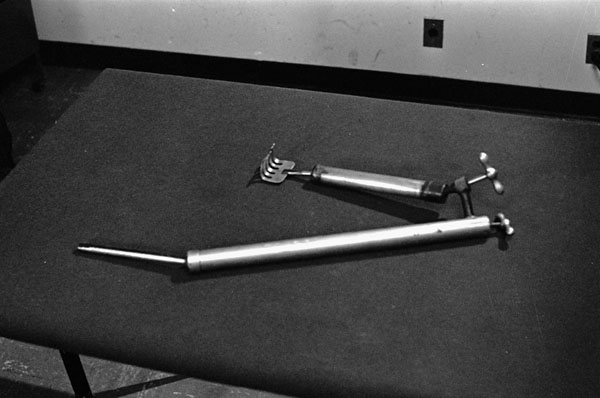
Photograph of scapula lifter and retractor instrument invented by Dr. Norman Bethune, circa 1966

Source
Scapula lifter and retractor instrument invented by Dr. Norman Bethune, circa 1966

It was a productive time for Dr. Bethune. He invented or re-designed 12 medical and surgical instruments, some of which are still used today. He also wrote a large body of work describing his innovations in thoracic technique. These books provided essential reference material for surgeons.

But slowly, Dr. Bethune became disillusioned with surgical treatment and more concerned with the socio-economic aspects of disease. He was constantly challenging his profession and proposing reforms of medical care, including socialized medicine. As an example to others, he opened a free clinic where he treated women, children and unemployed men.

First brush with communism

In 1935, Dr. Bethune attended a conference in the Soviet Union and returned to Montréal with high praise for their medical system. Still convinced of the benefits of socialized medicine, he helped organize the Montreal Group for the Security of the People's Health, an organization dedicated to establishing socialized medicine in Canada. The Group's recommendations were met with complete indifference. Dr. Bethune became bitter and disillusioned.

Photograph  of Dr. Norman Bethune beside blood-transfusion truck during Spanish Civil War

Source
Dr. Norman Bethune beside blood-transfusion truck during Spanish Civil War

Off to Spain

Dr. Bethune formally joined the Communist Party in the winter of 1935. He felt that his own goals were perfectly reflected in those of the Party: to change the world for the better. When he saw that he could not accomplish his objectives in Canada, he decided to travel to Spain, which, in 1936, was on the verge of civil war.

A chance to make a difference

Norman Bethune was a man of action and here was his chance to act. No sooner had he arrived in Spain than he traveled to the front lines and jumped into action. His experience as a stretcher-bearer during the First World War taught him the importance of helping the wounded quickly. So he set up a blood bank close to the front lines and organized a mobile blood-transfusion service, the first of its kind. By the next spring, Dr. Bethune and his small medical team were giving up to 100 blood transfusions a day.

Dr. Bethune returned to Canada in 1937 to a hero's welcome. Still firmly committed to the war in Spain, he criss-crossed the country, trying to raise money for the anti-fascist cause. But there was little interest in that distant war, and Bethune became bitterly disappointed.
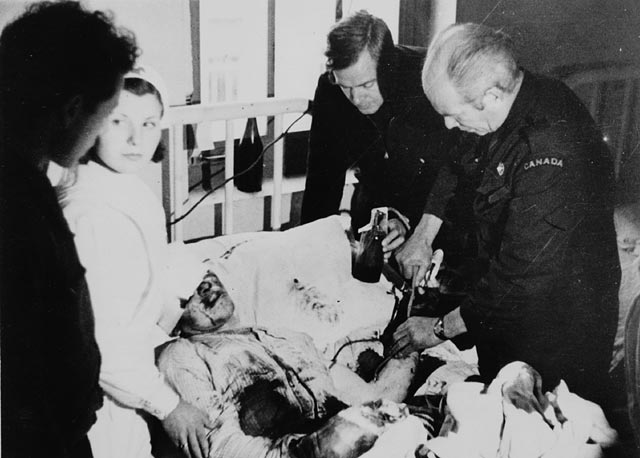
Photograph of Dr. Norman Bethune, assisted by Henning Sorensen, performing a blood-transfusion during the Spanish Civil War

Source
Dr. Norman Bethune, assisted by Henning Sorensen, performing a transfusion during the Spanish Civil War

A new cause to embrace

Once again, Dr. Bethune was growing restless, just as another war was escalating in the East. In 1937, the Japanese invaded China and Chinese Chairman Mao Zedong and his communist soldiers were trying to resist the Japanese invaders. Bethune saw this as another battle against fascism and he was determined to help.

He gathered together a medical team and on January 8, 1938, the Canadian-American Mobile Medical Unit left Canada to join the 8th Route Army in the Shanxi-Hobei border region of China. Once in China, Dr. Bethune immediately adopted the cause and the people as his own. He worked long hard days under the most rudimentary conditions and quickly became known as a skilled surgeon and a dedicated teacher.

In October 1939, the Japanese launched another attack. Dr. Bethune and his team rushed to the front where the worst fighting was unfolding and worked long hours caring for the wounded. While he was operating on a soldier, Bethune cut his finger. Probably due to his weakened state, he contracted septicaemia (blood poisoning) and died of his wounds on November 12, 1939.

A nation mourns

Dr. Bethune's death shocked the Chinese nation. Chinese Chairman Mao Zedong wrote a tribute titled "In Memory of Norman Bethune," in which he praised the doctor for his selflessness and dedication to the Chinese people.

In 1952, Norman Bethune's body was moved to a memorial park built to commemorate those who died in the war. Across the road from Bethune's tomb and statue lies the most fitting tribute of all: the Norman Bethune International Peace Hospital.

Canada too marked Norman Bethune's passing by naming his birthplace in Gravenhurst, Ontario, a national historic site and unveiling a bronze statue of him in downtown Gravenhurst.

Dr Norman Bethune

I have found another photo of Dr Norman Bethune taken in France in 1937 which I hava added to my Album no. 49. We must not forget this great Canadian hero from the 1920s and 30s. He had a Verdun connection for having treated poor patients in Verdun in the 30s at the YMCA on Gordon street. Aside from the video made to honor Bethune, I was unable to find any mention of his connection with Verdun in the Guardian of that period.

Guy 

Saturday, June 23, 2012

Everyone likes a 'Who Dunnit' but They KNow 'Who Dunnit' In Verdun They Want to Know 'Who They Dunnit to'

Looking for the Victim in Verdun,they got the guy who did it,but who did he do it to?


MONTREAL - Montreal police are looking for a victim after an altercation at a Verdun apartment Saturday afternoon.

According to Const. Raphael Bergeron, police were called after residents of an apartment complex, located at the corner of 6th Ave. and LaSalle Blvd., heard a gunshot. When they arrived at the apartment, they found a man with blood on his shirt.

Witnesses identified the man as the shooter and he was arrested. He may face charges related to the possession of a weapon.

At this point, police do not know if the blood was a product of the gunshot, or a scuffle between the suspect and victim.

........................................................................................................................................................................-Les

Thursday, June 21, 2012

Could This be a Politicians Dog.......You Decide !

DOG FOR SALE


A guy is driving around the back woods of Montana and he sees a sign in front of a broken down shanty-style house: 'Talking Dog For Sale 'He rings the bell and the owner appears and tells him the dog is in the backyard.                    

The guy goes into the backyard and sees a nice looking Labrador retriever sitting there.

'You talk?' he asks.

'Yep,' the Lab replies.

After the guy recovers from the shock of hearing a dog talk, he says 'So, what's your story?'

The Lab looks up and says, 'Well, I discovered that I could talk when I was pretty young. I wanted to help the government, so... I told the CIA.

In no time at all they had me jetting from country to country, sitting in rooms with spies and world leaders, because no one figured a dog would be eavesdropping.'


'I was one of their most valuable spies for eight years running...

But the jetting around really tired me out, and I knew I wasn't getting any younger so I decided to settle down. I signed up for a job at the airport to do some undercover security, wandering near suspicious characters and listening in.


I uncovered some incredible dealings and was awarded a batch of medals.'


'I got married, had a mess of puppies, and now I'm just retired.'

The guy is amazed. He goes back in and asks the owner what he wants for the dog.

'Ten dollars,' the guy says.

'Ten dollars? This dog is amazing! Why on earth are you selling him so cheap?'

'Because he's a Bullshitter.  He's never been out of the yard'


.Ps: Thanks for the email....................................lol                                 - Les

Poverty in Montreal 2005 numbers,.Have Things Gotten Better in 2012 ?I Don't Know,but Verdun is not at the Bottom of the List(or the top)

Poverty in Montreal

Where it’s at, where it came from, where it’s going

by KRISTIAN GRAVENOR

Montreal is known for its nightlife, its bagels and its year-round festivals du homard, but it has a lesser-known and less-celebrated reputation too. For decades, we’ve ranked above all other big Canadian cities for poverty. If this burg were a store, we’d be Hardship ’R Us.

But where are the streets with no dough? Destitution is often imperceptibly found in otherwise unremarkable, sleepy tree-lined areas. In the April 1, 1999 Mirror, in their story “Down and Out in Montreal,” Philip Preville, Matthew Hays and Dominique Ritter looked at the city’s five poorest neighbourhoods. They were: Maisonneuve, the Gay Village, Pointe St-Charles, Côte des Neiges’s Victoria district and Park Extension.

By analyzing reams of data from the 2001 census, the Montreal public health administration and the provincial Health Ministry poverty map (www.msss.gouv.qc.ca/statistiques/atlas/atlas/indicateurs/
defav/fc_pauvrete_2001.php
), the Mirror has peered once again through those brick walls into the hand-me-down, hardscrabble city of foodbank pasta, waiting for the mailman on the first of the month and fantasy of big lotto lucre. Some places have improved, others haven’t.

So enough with the contextualization and rhetorical flourish. Here are Montreal’s poorest neighbourhoods, based on welfare rates, income, home ownership and education.

St-Henri Serious poverty reigns in about a third of the fast-polarizing area of St-Henri, if you believe the 2001 census. Nowadays, the neighbourhood made synonymous with scarcity by Gabrielle Roy’s WWII classic The Tin Flute isn’t entirely dollar deficient. Have-nots live cheek-to-jowl with brie-eating urbanites, but the persistent pockets of poverty lie in Turcot Village (just east of the Turcot Yards) and as well as parts of Little Burgundy and several blocks around Atwater. Over 27 per cent of all St-Henri residents receive welfare, well above the city average of 12 per cent.

St-Michel This is a largely working-poor area, home to 55,000, of whom only 19 per cent receive welfare. The typical St-Michel adult earns $18,414 a year, compared to the city average of $28,258. About 30 per cent have less than a grade nine education, twice the city average. Poverty is particularly dire around Boulevard Industriel between St-Michel and Pie IX.

Park Extension The 30-odd-block, formerly Greek, now somewhat East Indian, immigrant crash pad is often deemed the city’s—even the country’s—poorest neighbourhood. All but two blocks were shaded as poverty zones on the Health Ministry poverty map. Six blocks on the north side of Jean-Talon fell into the most serious classification of poor. One in four Park Ex residents collects welfare. That’s down from 35 per cent during the mid-’90s Montreal meltdown, but nevertheless twice the city average. City councillor Mary Deros suggests that poverty has since been reduced.

“People are renovating, there’s upkeep and investment,” she says. “You’ll see the cars parked outside, and they’re not cheap cars.” New libraries, a community centre and a swimming pool have improved lives for the locals, but Deros admits that cleanliness remains a challenge.

Hochelaga-Maisonneuve A few years back, you could have mailed a postcard from povertyland from a giant chunk of the city, anywhere from Frontenac to Viau between Sherbrooke and the river. In 2001, that giant bastion of barrenness melted down to a much smaller series of reluctant toeholds. Cupboards remain bare mainly near the river as well as other zones deep in the ’hood, such as around Adam and Davidson. But even that data could be outdated, as sections such as Préfontaine and Ste-Catherine E.—an area once fondly known for its unabashed crack hookers—have also been redone since those numbers were collected. In 2004, 29 per cent of Hochelagans were on welfare, down 10 per cent from its 1997 peak.

Montreal North The working women of this area earn an average of $17,000 per annum, making them the lowest-earning group in the city. Compare that to best paid: $118,444 annual income of a Westmount male. And many of those women feed families on that wage—40 per cent of all area families are headed by a single parent, dwarfing the 25 per cent overall city rate.

While poor blocks were found throughout Montreal North in 1996, the east side nowadays is the main holdout, above Henri-Bourassa from Monty to Lacordaire. The former municipality is home to the most poor people of any district and has an increasingly bad reputation—largely undeserved—for street crime. Half pay more than one-third of their income on rent, and 41 per cent live below the poverty line.

Pointe St-Charles Unlike other areas where poverty has diminished, almost every block in the Point gets painted with the blackest of ink on the poverty map. The only areas that were deemed un-poor, according to the provincial poverty map, were a couple of blocks near Hibernia, a few standouts near the canal and about half of the area south of Wellington. Half of families live under the poverty line. About half of all homes here are some form of public housing, so they’re there to stay.

The Point also retains its comfortable lead in the concentration of welfare recipients—33.5 per cent. It’s also tops in single-parent families, double the city average. In fact, there are as many single-parent families as dual parent families in the area, and 21 per cent of all residents have less than a grade nine education.

How to tell if your ’hood is heading south

Poverty is too poor to afford a moving van, which is why you see mainly the same areas remaining poor. But bare cupboards could be slowly creeping from the inner city to what were once considered suburbs. Poverty is moving, says McGill urban studies prof Raphaël Fischler. He has some notions on how to spot an area in transition from suburb to slum.

“It’s related to the quality of the housing stock,” he says. “In older suburbs, where the population is reaching retirement age, there’s going to be a lot of supply of housing on the market. And in places where the quality of the building stock is not so high, middle income earners will not want to buy these houses. They may prefer to go to new housing further out. Even though one can’t predict the future, the thing to watch out for is low-density, old suburbs with poor housing quality.”

Fischler has more hope for areas rife with abandoned, buggy-and-whip industries. “With really old industrial zones that have become brownfields, new housing of good quality can be put in—we’re talking Verdun, Lasalle, Lachine,” he says. “There’s less demand for places not well-served by public transit, commerce, parks and playgrounds, so watch out for that.”

Also check out the main drag in your home turf. Consider empty storefronts a warning. “These places might fall between the cracks,” he says. “If you see a commercial strip not doing well, even in a place that wasn’t necessarily traditionally, historically poor, that might be part of the next wave of concentrated poverty.”

More poverty tidbits

• Ville St-Pierre—or St-Pierre, as it’s part of Montreal now—retains some alarming poverty. The blocks along St-Jacques are poorer than they were a decade ago.

• Parts of Montreal East, near the riverside, are new to the poverty map.

• Côte-St-Paul, Ville Émard and lower NDG all had scattered areas of poverty in 1996, but no more.

• From Marcel-Laurin Boulevard to about five blocks east, you’ll find penury all the way up. It’s poor and getting poorer.

• In Lachine, the area around Park Lasalle has been added to the city’s poor zones.

• Poverty in Verdun, once scattered as far west as the avenues, has been reduced to the blocks east of de l’Église.

• The richest? 1) Westmount 2) Hampstead 3) Town of Mount Royal 4)Beaconsfield 5) Montreal West.


Tuesday, June 19, 2012

Wacky Wisdom-----Hmmm maybe not so wacky

..Thanks for the email...Cheers ! HF&RV ...If this photo is too small,press & hold your control button,and then scroll your wheel up or down,to enlarge the picture or text you want to see.........- Les

ps: You can also just click on this photo to enlarge it................

Maybe in Mayberry, but in Sleepy Hollow Montreal.......

This just in Morning Coffee Breaks have been banned by the Montreal Police,as it just keeps the officers Tossing & Turning in their cars all day.............lol
More Montreal cops having a little 'nappy-poo' while on the job.......

MONTREAL - A Montreal man who snapped photos of two police officers snoozing in their police cruiser Tuesday said one of the officers didn’t appear to be bothered that he had been caught napping on the job.

The man, who identified himself only as Alan, said both police officers were sound asleep when he knocked on the window to wake them up.

“One of them jumped and pulled up his hat,” Alan said. “When I asked him whether it was nap time, he just shrugged.”

Alan said he was slightly amused by the scene, but also a little bit angry that officers in uniform, whose salaries are paid by taxpayers, would be catching 40 winks while on duty.

“If I am on a break at work, I can’t kick my feet up and take a nap,” he said. “There were two of them there; surely their breaks could be staggered.”

The pictures were taken about 11 a.m. as the officers were parked at the intersection of Décarie Blvd. and Royalmount Ave. Police officers had been directing traffic at the intersection over the past few days, Alan said.

Commander Ian Lafrenière, a spokesperson with the Montreal police, said the department does not tolerate officers sleeping in their police cruisers. He said the officers will meet with their commander on Wednesday and “sanctions will be taken.”

Lafrenière acknowledged that the photo is bad for the force’s image.

“You are not serving the citizens when you are doing that,” he said, adding that it is unsafe for officers to sleep in the vehicles because it puts them at risk of being harmed.

He said both officers worked late Monday night, but said that was no excuse.

Police officers are entitled to a 45 minute break during their 9 1/2 hour shift, said Martin Desrochers, a spokesperson for the Montreal Police Brotherhood.

He said it was difficult for him to comment on the photo because he wasn’t aware of the circumstances under which it was taken.

But he did say that: “It is not forbidden to close your eyes in a car during your lunch break.”

Last month, a Gazette photographer spotted a number of police officers snoozing inside a Société de transport de Montréal bus, the main means of transportation for the hundreds of men and women on the force who work during the nightly student protests.

There is no limit to the number of hours that a Montreal police officer can work in a given week, and officers do not have the option of refusing overtime shifts, Desrochers told The Gazette last month.

However, officers must be provided with no fewer than seven hours off between work periods, he said.

It is not known whether the police officers in the pictures taken Monday had been working overtime.

Alan said he doesn’t have much sympathy for officers sleeping on the job, even if they had been working overtime.

“I am sure they’re getting paid sweet overtime money,” he said

Maybe they are tired from lack of sleep during the student protest time............lol   - Les